
Ready to Experience the Power of Possibility?
Optimizing Citrate Plasticizers in Pharmaceutical Tablet Coatings for Enteric Coated Drugs
Blog
Why Plasticizers Matter in Tablet Coatings
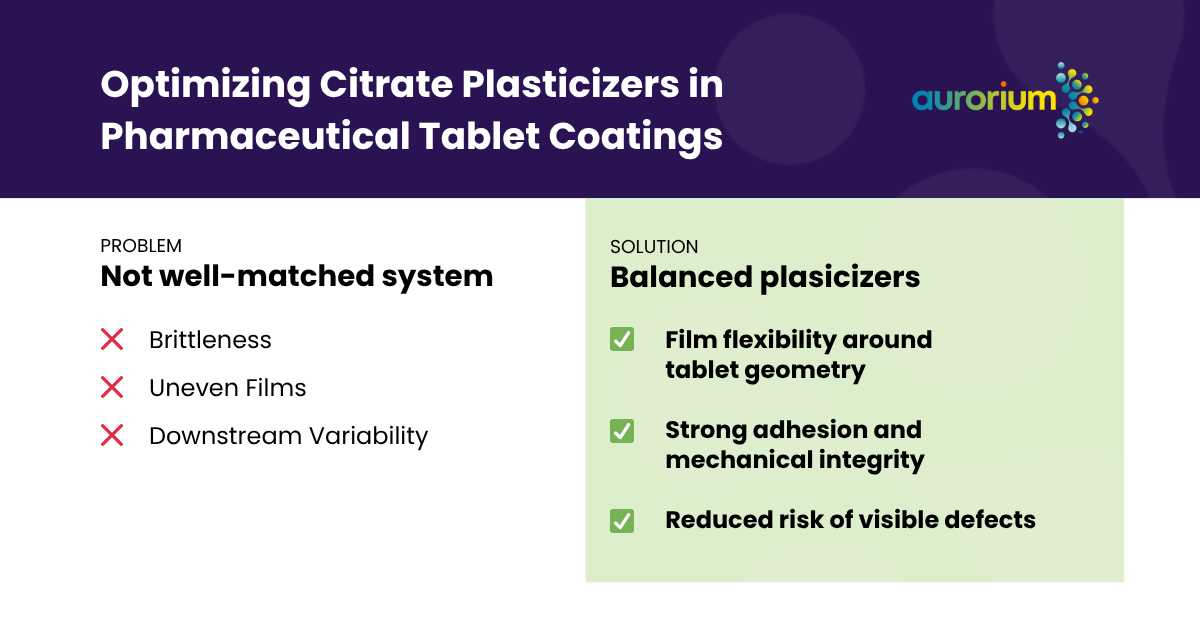
In enteric coated dosage forms, the coating film must withstand mechanical stress throughout processing and handling. Insufficient flexibility can result in film brittleness, increasing the risk of cracking during coating, drying, or downstream operations.
Plasticizers play a central role in enabling reliable film formation. By increasing polymer chain mobility, they reduce the glass transition temperature (Tg) and support effective coalescence under typical coating conditions, resulting in a continuous, mechanically resilient film.
Plasticizers can also lower the minimum film forming temperature (MFFT), helping films form uniformly and reducing the likelihood of brittle, defect prone coatings during application and scale up.
Published excipient guidance notes that citrate plasticizers can reduce Tg/MFFT. It also reports compatibility with cellulose-based polymers, polyvinyl acetate (PVA), and acrylates used in controlled-release and enteric coating systems.
Plasticizer-related defects are usually visible in the finished film. Low plasticizer levels can increase brittleness and cracking risk, while excessive levels can increase tack, blocking, and twinning. Plasticizer loss or migration over time can also shift film properties, so temperature and drying conditions should be considered during development and scale-up.
This article outlines where TEC and ATBC are commonly applied, where dibutyl sebacate can be useful, and which formulation and process variables matter when scaling enteric coating systems.
What Plasticization Does in Pharmaceutical Coating Films
The objective of plasticization is to enable consistent film formation during coating while maintaining sufficient flexibility and integrity for handling and downstream performance.
Film Flexibility, Adhesion, And Mechanical Integrity
A film coat is made of a network of plasticized polymer. When appropriately plasticized, the film can accommodate deformation rather than fracture.
This helps with better coating around tablet sides, score lines, and debossing. Enteric-coated dosage forms depend on coating integrity; cracks can compromise barrier performance and lead to variable release behavior.
Processing Impact During Coating Application
Plasticizers affect drying and film-formation kinetics. It is usually better for film formation when the bed temperature is lower, but if drying takes longer than expected, it can make the film stickier. Also, not all plasticizers remain affixed. For example, TEC material can be lost during higher-temperature processing, which can reduce the plasticizer level in the finished film.
Citrate Plasticizers in Pharmaceutical Tablet Coating Systems
Citrate plasticizers are commonly selected when formulators need a regulatory-acceptable way to improve coating performance without compromising film quality.
Where Citrate Plasticizers Typically Fit
Oral solids often utilize citrate esters because formulation teams and regulators know how to use them and they work well with many polymer systems. TEC is usually sold as an enteric layer plasticizer that makes things more flexible and easier to work with.
ATBC (acetyl tributyl citrate) is often selected when greater compatibility with less polar systems is required compared with TEC.
Literature on excipients talks about how ATBC is used in pharmaceutical coatings for solid oral dosage forms.
Compatibility Considerations with Common Coating Polymers
Polymer–plasticizer compatibility is often the determining factor in coating performance.
If you see haze or whitening, weak spots, or heterogeneous dissolution, you should think about phase behavior and movement.
Guidance from the TEC supplier indicates that it can be used with acrylates, PVA, and cellulose derivatives. Compatibility is typically confirmed using a focused screening set, such as DSC to assess Tg shift, basic film mechanical testing, microscopy, and short stability and dissolution evaluations.
Polymer Selection and Coating System Fit
PVA Based Coating Systems in Practice
A PVA-based coating is often used for protective topcoats and coatings that release quickly. It is often mixed ahead of time to make scaling up easier. PVA has been used for a long time to coat tablet films, and many businesses use established PVA-based systems for tablet film coating.
Enteric coating for drugs still needs to be tuned with a PVA-based coating applied. If it's too hard, it chips, and if it's too soft, it scuffs or sticks.
Polymer–Plasticizer Compatibility and Common Trade-Offs
Polymer–plasticizer compatibility is a critical determinant of coating performance. Incompatible systems may exhibit defects such as haze, whitening, mechanical weakness, or non uniform dissolution behavior, often associated with phase separation or plasticizer migration.
Citrate plasticizers are generally compatible with a range of commonly used pharmaceutical coating polymers, including acrylate based systems, polyvinyl acetate (PVA), and cellulose derivatives. However, compatibility should be confirmed experimentally for each formulation rather than assumed.
A focused screening approach is typically used, including differential scanning calorimetry (DSC) to assess glass transition temperature (Tg) shifts, basic film mechanical testing, microscopy to evaluate phase uniformity, and short term stability and dissolution studies to verify performance.
The following comparison highlights general characteristics of plasticizers commonly discussed in pharmaceutical tablet coating systems:
| Plasticizer | Observed Characteristics | Formulation Considerations |
|---|---|---|
| TEC | High compatibility with polar polymers | Volatility, migration |
| ATBC | Lower volatility, better hydrophobic compatibility | Slower distribution |
| Dibutyl sebacate | Low water affinity, good flexibility | Compatibility must be verified |
Differences in plasticizer polarity, volatility, and water affinity can influence film formation behavior, moisture sensitivity, and long term stability depending on the polymer system and processing conditions. As a result, formulation trade offs are best evaluated at the system level, considering both material properties and the operating conditions used during coating and drying.
Ultimately, coating performance is governed by the polymer–plasticizer system, with polymer selection defining the operating window for plasticization.
Practical Optimization Levers for Formulators
Optimizing a coating often comes down to a few controllable levers, and plasticizer level is usually the first one formulators adjust because it directly shifts film feel, process robustness, and final performance.
Plasticizer Level and Formulation Balance
Mostly, teams establish the plasticizer as a proportion of the polymer solids, after which they fine-tune according to defects and dissolution. Published studies have evaluated TEC at 0%, 5%, 10%, 15%, and 20% (w/w of polymer), demonstrating how plasticizer concentration influences coating performance and drug release. Coating performance remains strongly dependent on plasticizer concentration and system-specific factors.
A typical optimization workflow includes:
- Start mid-range; coat a small lot
- Check tack/defects, Tg shift, and acid stage integrity
- Add small increments and reassess performance
Improvements in film flexibility should not compromise acid‑stage integrity or enteric performance.
Process Variables That Influence Film Quality
Many coating defects can be traced to three interacting variables:
- Temperature Balance: Too hot can drive TEC loss; too cool can trap water.
- Spray vs Drying Capacity: Lack of fit leads to roughness/ sticking.
- Cure Time: There are films that require coalescence and stable release.
Common Failure Modes and What They Usually Indicate
- Cracking: insufficient plasticizer level, over drying or film thickness is too low.
- Sticking/Twinning: plasticizer level is too high, over wetting.
- Haze/Whitening: Phase separation, moisture uptake, or migration.
Application Context and Example References
The purpose of enteric coatings is to provide protection to acid-sensitive APIs, as well as to minimize the risk of gastric irritation with some drugs, such as NSAID-type molecules. That is a typical design of oral solids in small molecule drug delivery.
Example: Within salicylates medications, magnesium salicylate is a useful reference case when discussing enteric tablet coating systems. The formulation focus is the coating film: polymer choice, plasticizer compatibility, and process conditions that deliver a continuous, defect-resistant plasticized polymer layer.
Citrate plasticizers can improve flexibility and coalescence, but level and processing must be controlled to avoid tack, excess moisture sensitivity, or plasticizer migration. The same considerations apply where PVA-based coating systems sit within broader coating formulations.
Formulation reference points: In enteric coating work, the most useful reference points are consistent across the excipient literature and technical guidance: how the plasticizer shifts Tg/MFFT, whether the polymer-plasticizer system remains single-phase, and how film properties hold under process and storage conditions.
In practice, formulators typically confirm fit with a small set of checks, for example DSC for Tg shift, basic film mechanical testing, microscopy for phase separation, and short stability and dissolution screens, before locking a formulation for scale-up.
Quality and change control: As these are human-health excipients, performance has to be repeatable. Specify compendial grade where applicable, confirm batch-to-batch consistency via CoA controls, and ensure change control expectations are clear so the coating system behaves predictably across lots and manufacturing sites.
Keep claims material-function-oriented (film flexibility, processability, compatibility) and avoid clinical effect language. For enteric coating for drugs, specify compendial grade where applicable, confirm batch-to-batch consistency via CoA controls, and ensure change control expectations are clear so performance stays predictable across lots and manufacturing sites.
Key Takeaways
- Plasticizers play a functional role in enteric coating systems, influencing both processing robustness and film performance.
- TEC and ATBC are popular citrates used to help films form better. Dibutyl Sebacate, on the other hand, is a tried-and-true, less water-attracting alternative that is used in tablet film coatings.
- First make sure that the polymer and plasticizer work well together.
- The plasticizer level and process conditions can then be adjusted to balance flexibility, adhesion, and long‑term film stability.
For support selecting and optimizing citrate plasticizers for tablet coating systems, contact our technical team. You can also view product information for Acetyl Triethyl Citrate (ATEC), Dibutyl Sebacate, ATBC, and Triethyl Citrate.