
Ready to Experience the Power of Possibility?
Improving Peptide Purity in TIDES Workflows with Piperidine Reagents
Blog
Peptide purity is rarely decided at the final purification alone. In TIDES workflows, which encompass the development and manufacture of therapeutic peptides and oligonucleotides, peptide purity is shaped earlier through repeated synthesis, deprotection, washing and work-up steps where small variations can create impurities that carry into the crude profile.
That is why piperidine quality matters. As a deprotection reagent in Fmoc-based peptide chemistry, piperidine helps prepare the growing sequence for the next coupling step. When reagent quality attributes are appropriately controlled, teams can help reduce variability, limit unwanted reactions and support downstream purification performance.
For peptide drug synthesis and peptide-based therapeutics, this control is not a minor process detail. It can support process consistency, facilitate investigations of variability and contribute to more predictable scale-up from development into supply.
Where Purity Risks Typically Enter The Process
Solid-phase peptide synthesis, usually shortened to SPPS, builds a peptide chain one residue at a time while the growing sequence stays attached to a resin. Each cycle depends on coupling, deprotection and washing steps doing their job cleanly and efficiently enough before the next begins.
That is where peptide purity can start to move off target. A coupling step runs short. A wash leaves more carryover than expected. A reagent performs within a loose specification, but not tightly enough for a difficult sequence. None of these issues has to be dramatic on its own. Repeated across a longer synthesis, they can change the crude profile enough to make downstream purification difficult resulting in low yields of product.
Coupling Efficiency and Residuals
Incomplete coupling is one of the common routes into lower peptide purity. A missed or poorly driven step can leave truncated sequences that co-elute with the intended peptide when the batch reaches purification.
Residual coupling reagents and longer than optimal reaction times add another layer of risk. Activated esters and Uronium salts, including HATU or HBTU, can remain on the resin or in the reaction mixture if washing is not controlled closely. Once carried forward, they may keep reacting beyond the intended coupling stage.
At lab scale, the result may be extra method development. At manufacturing scale, the same chemistry can mean longer purification runs, more solvent use, lower recovery and greater batch risk.
Side Reactions and Impurity Profiles
Some sequences are simply harder to run cleanly. Sterically hindered couplings such as Pro-Pro can lead to long reaction times and incomplete conversions.
Asp-Gly and Asp-Ser motifs can be prone to aspartimide formation and epimerization of the amino acid stereocenter. Methionine residues can oxidizeSome sequences are simply harder to run cleanly. Sterically hindered couplings such as Pro-Pro can lead to long reaction times and incomplete conversions. Asp-containing sequences, particularly Asp-Gly and Asp-Ser motifs, may be susceptible to aspartimide formation, which can generate related impurities including regioisomers and epimerization products. Methionine residues can oxidize, acid-labile side-chain protection can be lost too early, and diketopiperazine formation at the N-terminal dipeptide stage can also add unwanted species.
Acid-labile side-chain protection can be lost too early. Diketopiperazine formation at the N-terminal dipeptide stage can also add unwanted species.
The crude profile usually reflects the process history. Solvent choice, temperature, exposure time, reagent grade and wash efficiency all leave evidence. For teams working in peptide chemistry, piperidine and other key reagents cannot be treated as background inputs. They influence how much work is left for purifying peptides later.
What Piperidine Reagents Are Used For In Practice
Piperidine reagents are most commonly used as the deprotection reagent in Fmoc-based peptide chemistry. In practical terms, they remove the Fmoc protecting group so the growing peptide chain is ready for the next coupling step.
That step is repeated many times during peptide drug synthesis. Any inconsistency in deprotection can carry into the next cycle, which is why piperidine quality matters well before final purification begins. This is best illustrated by the presence of n-pentyl amine in piperidine.
Primary amine impurities such as n-pentylamine can react with activated coupling intermediates. Depending on concentration and process conditions, these reactions may contribute to chain termination products or other process-related impurities.
Deprotection Steps and Process Control
A typical Fmoc deprotection method uses piperidine at around 20% v/v in DMF, although some processes use lower concentrations or alternative base systems to manage sequence-specific risks such as aspartimide formation.
The reaction is usually fast, often run as one or two short treatments. After deprotection, the piperidine-dibenzofulvene adduct must be removed through controlled washing before the next coupling step.
If reagent quality varies, deprotection can become less predictable. Water content, residual impurities or concentration drift may affect reaction performance, increase side reactions and leave more work for purifying peptides downstream.
For longer sequences and peptide-based therapeutics, those small shifts can become costly.
Handling Considerations In Manufacturing
Piperidine is a flammable, corrosive liquid with a strong amine odour, so manufacturing teams manage it through closed handling, suitable ventilation, defined PPE and site-specific safety controls.
Storage also matters. Exposure to air and moisture can affect reagent condition over time, including reaction with carbon dioxide.
For CMOs, CDMOs and pharma teams running multiple TIDES campaigns, controlled storage, validated shelf life and consistent documentation are part of the process, not an afterthought.
Work-Up and Purification: Supporting Cleaner Outcomes
Purification does not rescue poor upstream control without cost. If deprotection, coupling and washing leave a heavy impurity load, that burden moves straight into work-up and preparative purification.
Work Up Peptide Coupling Considerations
A clean work up peptide coupling process depends on disciplined washing between cycles. Resin washing removes excess reagents, unreacted materials and byproducts such as the piperidine-dibenzofulvene adduct before the next coupling step begins.
Poor washing is easy to underestimate. It may not stop the synthesis, but it can leave carryover that reacts later, adds minor species to the crude profile or makes closely related impurities harder to separate. In peptide chemistry, those small changes can be expensive once the batch reaches purification.
After global deprotection and cleavage, teams typically remove TFA and scavengers through precipitation into cold ether or MTBE, followed by isolation of the crude peptide. The quality of that crude material depends heavily on how tightly the earlier synthesis steps were controlled.
Purifying Peptides: Practical Checks And Controls
Purifying peptides at clinical or commercial scale often relies on preparative reversed-phase HPLC.
C18 and C8 stationary phases are common, with acetonitrile/water gradients and ion-pairing agents used to separate the target peptide from shortened sequences, deletion analogues, oxidation products and other closely related impurities.
This is where upstream reagent quality becomes visible. A cleaner crude profile can reduce purification pressure, improve recovery and make fraction selection more predictable.
Analytical HPLC is commonly used to track purity across crude material, purified fractions and final bulk. Mass spectrometry confirms identity and helps detect low-level impurities that may co-elute. Depending on the programme, teams may also use amino acid analysis or NMR for additional confirmation.
For peptide purity targets, these checks work best when the synthesis process has already reduced avoidable impurity formation.
For some peptide processes, attributes such as assay, water content and specified impurity levels may also be evaluated as potential Critical Material Attributes (CMAs) because of their influence on process robustness, impurity formation and downstream purification performance.
Supply and Quality: What Teams Look For in Peptide NCE Programs
Piperidine is not a reagent most teams want to requalify mid-program. Once a peptide process moves beyond early development, sourcing decisions become part of the quality strategy.
For peptide NCE supply, buyers are usually looking for three things: consistent assay, clear impurity control and documentation that can stand up to technical review. Price matters, but it is rarely the deciding factor once the programme is moving toward clinical or commercial manufacturing.
Documentation, Consistency and Risk Reduction
For piperidine reagents used in peptide drug synthesis, the documentation package needs to be specific. A useful Certificate of Analysis should report measured values, not broad assurances. Typical checks may include assay by GC or titration, Karl Fischer water content, evaporation residue and defined impurity limits.
That level of detail helps process teams understand what they are introducing into the synthesis. It also supports QA review, supplier qualification, change control and audit readiness.
Lot-to-lot consistency is just as important. A shift in water content, assay or impurity profile can alter deprotection performance and change what appears in the crude peptide. For teams developing peptide-based therapeutics, that is a real process risk, especially when the sequence is long or sensitive to side reactions.
Scale-Up Considerations
Scale-up makes weak reagent control more visible. A variation that looks manageable at gram scale can create a much larger problem when reagent volumes, mixing demands and batch value increase.
At this stage, specialty-grade supply matters more than a simple material purchase. Teams need a piperidine supplier that can support repeat campaigns, provide clear documentation and maintain consistent quality across larger-volume requirements.
For peptide purity targets, cleaner chemistry upstream can reduce pressure on downstream purification. It can also support more predictable work-up, fewer avoidable investigations and stronger confidence as a process moves from development into larger-scale supply.
Key Takeaways
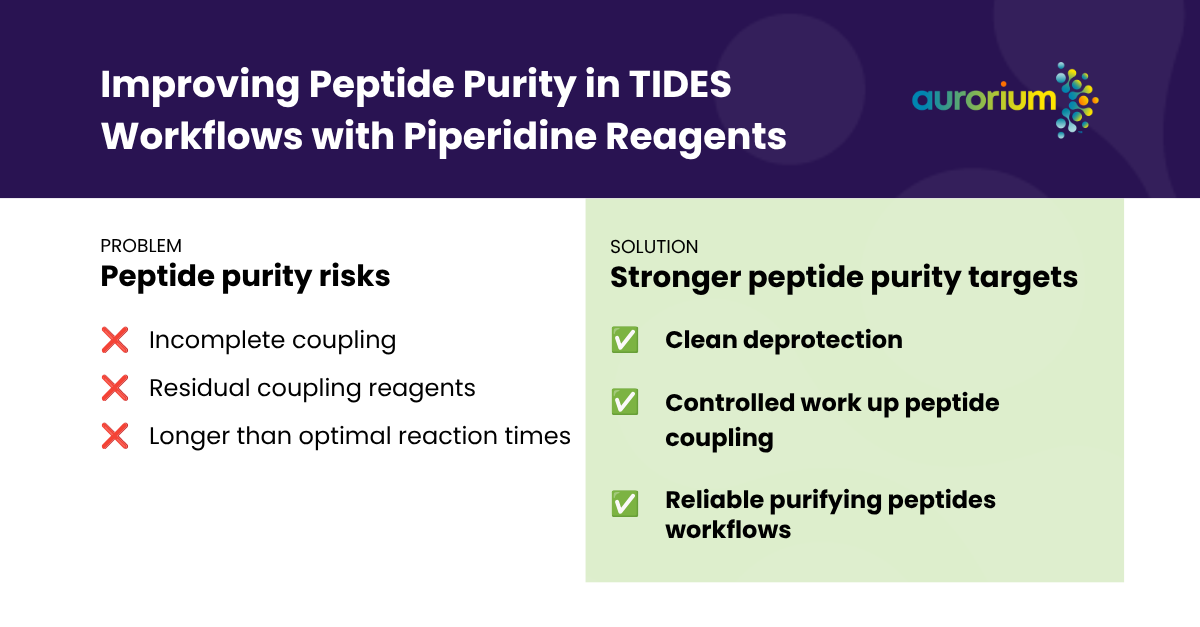
Peptide purity starts upstream. Piperidine is used repeatedly as the deprotection reagent in Fmoc-based peptide chemistry, so changes in assay, water content or impurity profile can show up later as harder work-up, heavier purification and weaker process control. At manufacturing scale, purification is frequently a major contributor to manufacturing cost, solvent consumption and process time, making it one of the most resource-intensive stages of peptide production. For teams managing peptide NCE supply, reagent sourcing is a quality decision. Clean deprotection, controlled work up peptide coupling and reliable purifying peptides workflows all support stronger peptide purity targets.
Ready to Strengthen Your TIDES Chemistry?
Aurorium supplies specialty-grade piperidine reagents for peptide drug synthesis, TIDES workflows and peptide-based therapeutics. To review reagent quality, documentation needs or scale-up requirements for an active or future program, reach out to Aurorium’s technical experts.