
Ready to Experience the Power of Possibility?
NaOH Solution in Biopharma Excipients and pH Control
Blog
In biopharma manufacturing, pH control is treated as a process requirement with direct implications for stability, compatibility and batch release.
That makes NaOH solution a critical input across formulation and process workflows. It is used for pH adjustment in buffer preparation, upstream process control, excipient systems and downstream operations, including Fill and Finish where controlled conditions matter close to final product handling.
Sodium hydroxide is familiar chemistry, but pharmaceutical use depends on specification, grade and traceability. For pharma, R&D, CMOs, CDMOs and procurement teams, sodium hydroxide solution needs to be consistent, documented and suitable for the intended use. In biopharma, the quality of the base can affect the quality of the process.
Where a NaOH Solution Is Used in Biopharma Workflows
A NaOH solution can appear at several points in a biopharma workflow, from early buffer preparation to downstream handling. Its role changes by process stage, but the requirement stays the same: controlled pH adjustment using a sodium hydroxide solution that is suitable for the intended use.
Sodium hydroxide solution supports multiple stages of biopharma manufacturing, with each application requiring accurate pH control and materials that meet the appropriate quality standards.
Formulation pH Adjustment and Stability
During formulation development, sodium hydroxide is commonly used to adjust the pH of the buffer systems such as phosphate, citrate, acetate or histidine to a defined pH range. Achieving the desired pH is critical because it can directly influence active pharmaceutical ingredient (API) stability, excipient compatibility, and overall formulation performance.
For biologic products, even small changes in pH may alter protein charge distribution, affect higher-order structure, and ultimately influence product stability. As a result, precise buffer preparation is an integral component of product quality rather than simply a manufacturing step.
The addition of sodium hydroxide must also be carefully controlled to maintain buffer composition, ionic strength, and formulation consistency. Within GMP manufacturing environments, these activities are performed using validated procedures supported by defined process parameters, comprehensive documentation, and full batch traceability.
Process pH Control and Repeatability
Beyond formulation, NaOH solution is an important process aid used throughout manufacturing operations. In upstream workflows, automated dosing systems may use sodium hydroxide to correct acidic drift in media or process streams, supported by calibrated pH probes and controlled addition rates.
Downstream, Clean in place (CIP) procedures often rely on caustic cleaning to remove residues from tanks, piping, chromatography systems and product-contact surfaces. The same quality logic applies near Fill and Finish operations, where pH control, cleanliness and traceability sit close to final product handling.
For process engineers and quality teams, repeatability depends on more than the pH reading. Concentration, grade, storage condition and supplier control all affect how predictably the NaOH solution performs.
Excipients and Buffer Systems: Practical Compatibility Considerations
In biopharmaceutical formulation, pH adjustment is far more than a final step before release testing—it is a critical factor in product quality and stability. The addition of a sodium hydroxide (NaOH) solution influences buffer capacity, ionic strength, excipient interactions, and the stability of the active pharmaceutical ingredient (API), making precise pH control essential throughout formulation development. That matters because excipients do not work in isolation. Sugars, surfactants, amino acids, polymers and salts all sit inside the same formulation environment.
Change the pH too quickly, overshoot the target or use a sodium hydroxide solution with variable concentration, and the formulation can move outside the range it was designed to tolerate.
Target Ranges, Buffers, and Control Strategy
Different biologics require different pH conditions. Many monoclonal antibody formulations are developed in mildly acidic ranges, often around pH 5.0 to 6.5, depending on the molecule. Some vaccines, enzyme-based products and small-molecule injectables may require different targets, including near-neutral conditions.
The buffer system defines how much control the formulation has against pH movement. Common systems include the following pH ranges commonly used in biopharmaceutical formulations:
- Histidine buffers (typically around pH 5.5–6.5): Often used in monoclonal antibody formulations where mildly acidic control is required.
- Phosphate buffers (typically around pH 6.0–8.0): Widely used where near-neutral pH control is suitable for the molecule and route of administration.
- Acetate buffers (typically around pH 3.5–5.5): Used in lower-pH formulations where the active and excipient system remain stable.
- Citrate buffers (typically around pH 3.0–6.2): Used across some liquid and lyophilized biologic formulations, depending on compatibility needs.
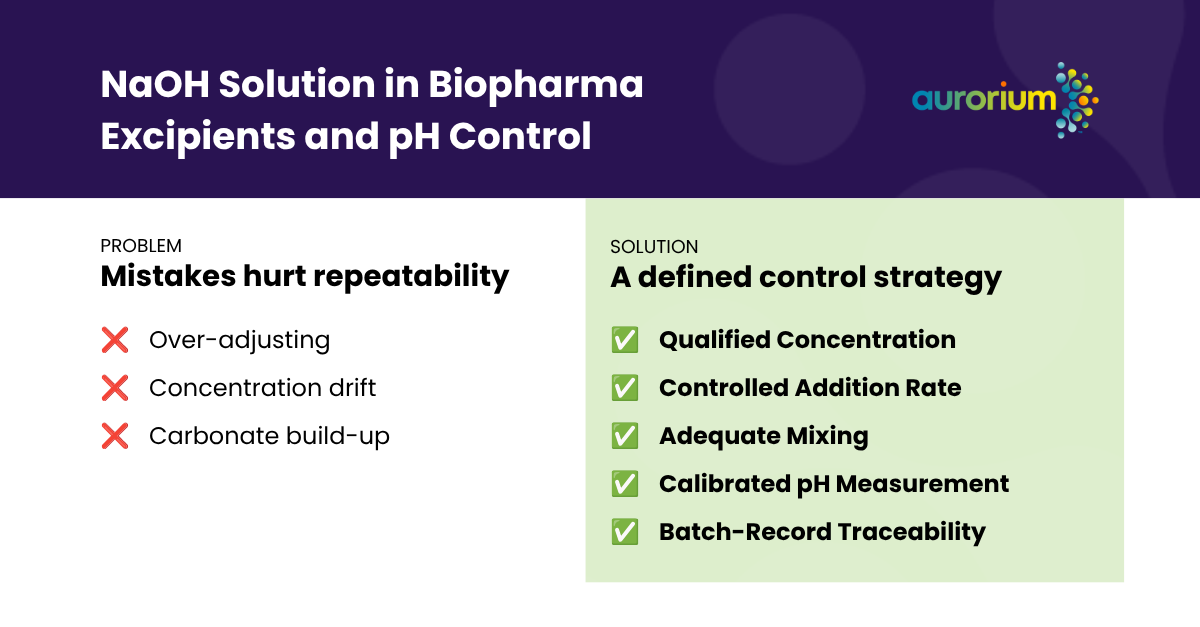
In GMP manufacturing, sodium hydroxide addition should follow a defined control strategy. That usually means qualified concentration, controlled addition rate, adequate mixing, calibrated pH measurement and batch-record traceability.
Common Risk Areas
Over-adjustment is one of the most practical risks. If too much NaOH solution is added, correcting the batch with acid can increase ionic load, shift osmolality and add avoidable variability to an already controlled formulation.
Concentration drift creates a second problem. If the labeled molarity of a sodium hydroxide solution no longer reflects its actual strength, the dosing calculation becomes unreliable before the addition even starts. This can happen when solutions are diluted in-house without strong controls, stored poorly or exposed to conditions that change effective alkalinity.
Carbonate formation also needs attention. Sodium hydroxide can absorb carbon dioxide from air, forming carbonate species that reduce effective base strength over time. Sealed storage, controlled handling and use within validated hold times help limit that risk.
For formulation scientists, process engineers and quality teams, these are not small housekeeping details. They affect pH adjustment, excipient compatibility and the repeatability of the final process.
Concentration, Handling, and Operational Controls
A NaOH solution is simple to identify on a batch record, but it needs tight control in daily use. Concentration, dilution practice, storage conditions and transfer method all affect how safely and predictably it performs.
Dosing, Dilution, and Mixing Practices
Concentrated sodium hydroxide solution is often supplied at high strength, including 50% w/w grades, before being diluted to working concentrations such as 0.1 M, 0.5 M or 1 M. The exact concentration used depends on the process, equipment, validation package and intended application.
Dilution needs care. Sodium hydroxide releases heat when mixed with water, and poor technique can cause localized boiling or splattering. Concentrated NaOH solution should be added slowly to water with suitable mixing, cooling and operator protection, not the other way around.
In GMP manufacturing, dilution is usually handled through inline mixing, controlled addition systems or dedicated dilution vessels with recirculation. Smaller-scale preparation still needs written procedures, trained operators and clear acceptance criteria. The working solution should be checked after dilution and equilibration, when the concentration and pH reading are stable.
For automated pH adjustment in bioprocessing, NaOH solution is commonly dosed through controlled pump systems linked to pH measurement. Pump calibration, probe calibration and batch traceability matter because dosing accuracy depends on all three, not the reagent alone.
Storage, Transfer, and Safety Considerations
Sodium hydroxide is highly caustic. Even diluted solutions can irritate or damage skin and eyes, while concentrated stock can cause severe chemical burns. Handling should follow site safety procedures, with suitable chemical-resistant gloves, eye and face protection, protective clothing and controlled transfer methods.
Container compatibility also matters. Concentrated NaOH solution is commonly stored in compatible plastics such as high-density polyethylene (HDPE) or polypropylene. Glass is not suitable for long-term storage, and some metals can be attacked depending on concentration, temperature and exposure time.
Temperature should be controlled where required. Viscosity, solubility and crystallization risk can change at higher concentrations, especially if storage conditions fall below the validated range. For biopharma manufacturing teams, storage and transfer are part of process control. Poor handling can affect operator safety, concentration accuracy and the reliability of pH adjustment.
Quality, Specification, and Supply Considerations
For biopharma use, a NaOH solution should be assessed by more than concentration alone. Grade, source material, documentation and supplier control all matter. Technical-grade or industrial-grade material does not belong in a GMP pharmaceutical workflow.
Documentation, Traceability, and Consistency
The compendial position is important. USP-NF and European Pharmacopoeia requirements apply to sodium hydroxide in solid pellet form. A pharmaceutical-grade sodium hydroxide solution is therefore made by hydrating compendia-grade pellets under controlled conditions.
That makes the starting material central to quality review. Procurement and quality teams should be able to trace the sodium hydroxide solution back to its solid source, supported by Certificate of Analysis documentation, lot history and defined change control.
Consistency matters just as much as compliance language. Variation in assay, carbonate content, metals or other impurities can affect pH adjustment, formulation performance and process repeatability.
For CMOs, CDMOs and biopharma manufacturers, supplier qualification should confirm both the grade of the material and the controls used to prepare, package and release the solution.
Supplier Context
The US supply base for compendia-grade sodium hydroxide pellets is limited. Aurorium is the only domestic US manufacturer of compendia-grade NaOH pellets, which makes domestic sourcing a practical consideration for teams qualifying sodium hydroxide solution for pharmaceutical use.
Other suppliers may sit in adjacent caustic supply markets, but biopharma teams need to check grade, traceability and intended-use fit rather than treating all sodium hydroxide sources as equivalent.
For sourcing and procurement teams, the decision is not only about availability. A controlled NaOH solution supply gives quality and procurement teams a clearer route through documentation, qualification and continuity planning across formulation, pH control and Clean in place (CIP) workflows.
Sodium Hydroxide Beyond Biopharma
Sodium hydroxide is used across several formulation environments, but the quality expectations change sharply by application. In biopharma, a NaOH solution is tied to pH adjustment, process control, traceability and GMP documentation. In personal care, the chemistry may look familiar, but the specification burden is different.
Sodium Hydroxide in Skin Care
Sodium hydroxide in skin care is most often used for pH adjustment or saponification. In soap manufacturing, it helps convert fats and oils into finished soap. In creams, gels and cleansers, small controlled amounts may be used to bring the final formulation into a suitable pH range for skin contact.
That context is useful because it shows how broadly sodium hydroxide can function as a pH control tool. The comparison should stay limited, though. Personal care products do not follow the same specification, documentation or traceability requirements as pharmaceutical workflows.
For biopharma manufacturers, sodium hydroxide solution is held to a higher standard because it can sit close to formulation stability, excipient compatibility, Clean in place (CIP), Fill and Finish readiness and batch-release expectations.
The chemistry may be familiar across industries, while biopharma manufacturing requires tighter control of grade, documentation and source material.
Key Takeaways
NaOH solution plays a practical role across biopharma workflows, from formulation pH adjustment and buffer preparation to upstream process control, Clean in place (CIP) and Fill and Finish readiness.
For pharmaceutical use, sodium hydroxide solution should be assessed by more than concentration alone. Grade, source material, traceability, documentation and supplier control all matter.
Over-adjustment, concentration drift and carbonate formation can affect repeatability, especially in excipient and biologics workflows. Since pharmaceutical-grade solution quality depends on compendia-grade sodium hydroxide pellets, supply qualification should be part of the quality discussion.
Talk to Aurorium’s Sodium Hydroxide Experts
Aurorium supplies pharmaceutical-grade sodium hydroxide solutions for biopharma pH adjustment, excipient workflows and process control. To discuss grade requirements, documentation, compendia-grade sourcing or supply needs for your program, reach out to Aurorium’s experts.