
Ready to Experience the Power of Possibility?
How Colloidal Sulfur Supports Skin and Scalp Care Formulas
Blog
Sulfur has always been a trusted therapeutic ingredient in skin and scalp care treatments. It remains relevant in personal care as both formulators and consumers are seeking milder and sustainable solutions for anti-acne and anti-dandruff products. Modern formulations require ingredients that effectively control excess oil, help minimize visible build-up and redness, are well tolerated by the skin, and are suitable for frequent use. Sulfur continues to meet these demands, making it a valuable active ingredient in treatment-focused personal care products. For brands developing products for acne-prone skin, dandruff treatments and scalp health, colloidal sulfur remains a multifunctional therapeutic active that helps meet both efficacy and consumer expectations.
What Is Colloidal Sulfur?
Colloidal sulfur refers to sulfur that has been processed into a very small particle size and dispersed or suspended within another material (typically a gum base) to improve handling and stability. Compared to traditional Sulfur formats, Colloidal Sulfur disperses much more readily in water. For formulators, Colloidal sulfur is a valuable therapeutic active with improved handling, easier dispersion and formulation flexibility, alleviating the clumping, settling, and other issues related to sulfur.
What Sulfur Does in Skin and Scalp Applications
Acne and dandruff are two conditions that share several common triggers for their development and manifestation, including the accumulation of dead skin cells, excessive sebum (oil) production, microbial overgrowth, as well as inflammation triggered by the immune response to microbiome imbalances. While the shedding of dead skin cells is a normal aspect of the skin renewal process, excessive accumulation can contribute to the development of acne and dandruff. In acne-prone skin, these excess skin cells can cluster and clog pores, resulting in inflammatory lesions, as well as whiteheads and blackheads. On the scalp, the overproduction of skin cells results in visible flaking that is characteristic of dandruff. In both cases, the build-up of dead skin cells also disrupts the skin barrier. Excess sebum creates an environment that supports microbial overgrowth, a contributing factor in both acne and dandruff development. Sulfur is valued as a multifunctional therapeutic active because it targets several of these underlying factors involved in acne and dandruff simultaneously.
Keratolytic Action
The keratolytic properties of sulfur contribute to its continued presence in over-the-counter products aimed at treating acne, dandruff, and scalp conditions. Keratolytics, such as sulfur, help loosen and remove excess dead skin cells from the skin’s surface. Sulfur helps soften the skin and unclog pores, effectively managing build-up in treatments intended for frequent or regular use.
Anti-bacterial and anti-fungal properties
Sulfur is recognized for its antibacterial and antifungal properties. An imbalance in the skin and scalp microbiome has been identified as a factor contributing to acne and dandruff. Acne is typically characterized by the overgrowth of certain bacteria, such as P. acnes, while dandruff is commonly linked to an excess of fungi, such as Malassezia species.
Anti-Inflammatory Functions
Inflammation associated with acne and dandruff is often triggered by the microbial overgrowth on the skin. Published literature suggests that sulfur derivatives may contribute to the reduction of inflammatory processes associated with acne and dandruff. The synergistic therapeutic effects maintain sulfur’s relevance as a treatment for both acne and dandruff. It enables formulators to tackle multiple conditions with a single active, which is especially beneficial in personal care treatment formulations where efficacy, simplicity and skin tolerance are critical.
Colloidal Sulfur in Acne-Focused Skin Care
Why Sulfur Is Used in Blemish-Prone Skin Formulas
Sulfur continues to be relevant in skin care for blemish-prone individuals, as it effectively manages excess oil, skin build-up, and visible redness. Additionally, it holds an established position in the over-the-counter acne category. In the United States, sulfur is an approved OTC active ingredient for topical acne drug products at concentrations. According to the current FDA monograph, sulfur is allowed at concentrations of 3% to 10% in acne products, and at 3% to 8% when combined with resorcinol or resorcinol monoacetate.
Where It Fits Versus Other Acne Actives
Sulfur is often considered by formulators as an alternative acne active (for example, to benzoyl peroxide and salicylic acid) where skin tolerance and formulation flexibility are important considerations. While it may not always be the primary choice, it is particularly valuable when factors such as tolerance, barrier support, and suitability for daily use are important, in addition to achieving visible results. The FDA monograph allows for benzoyl peroxide concentrations ranging from 2.5% to 10% and salicylic acid concentrations from 0.5% to 2% for over-the-counter acne treatments. Sulfur is often used as part of a more comprehensive array of active ingredients.
Colloidal Sulfur is effective in acne-focused formulations that require a milder alternative to harsher actives. It provides formulators with an additional option for treatment-oriented skin care, particularly in products aimed at addressing a wide variety of acne symptoms without increasing the harshness of the formulation.
Colloidal Sulfur in Dandruff and Scalp Care
Flake Control, Oil Balance, and Scalp Comfort
Sulfur is an established anti-dandruff active, effectively mitigating all symptoms associated with dandruff: flaking, increased sebum levels, itching and discomfort, compromised skin barrier, and fungal overgrowth.
In shampoo and scalp treatment formulations, Colloidal Sulfur supports the reduction of visible flaking while promoting a balanced microbiome and regulating sebum production. It provides formulators a means to create formulations that provide visible and perceivable scalp improvements and exceptional sensory performance.
Brands are increasingly focusing on shampoos that not only tackle dandruff but also address scalp issues by reducing flakes, controlling sebum, and soothing irritated skin in a single formulation.
Regulatory Landscape
The regulatory landscape for cosmetic actives is evolving, creating new opportunities for alternative antidandruff actives. Following the prohibition of Zinc Pyrithione (ZPT) in cosmetic products in the European Union since March 2022, formulators have been actively reformulating products with ingredients that offer effective dandruff control while meeting current safety and regulatory requirements.
Sulfur, with its long history of use in skin and scalp care, has emerged as a compelling alternative to ZPT. In the United States, it is approved as an over the counter (OTC) active ingredient for dandruff control at concentrations of 2–5%. In the European Union, dandruff shampoos are classified as cosmetic products, and the use of sulfur is permitted, as it is not included in Annex II (banned substances) or Annex III (restricted substances) of the EU Cosmetics Regulation (EC) 1223/2009.
Why Colloidal Sulfur Changes the Formulation Conversation
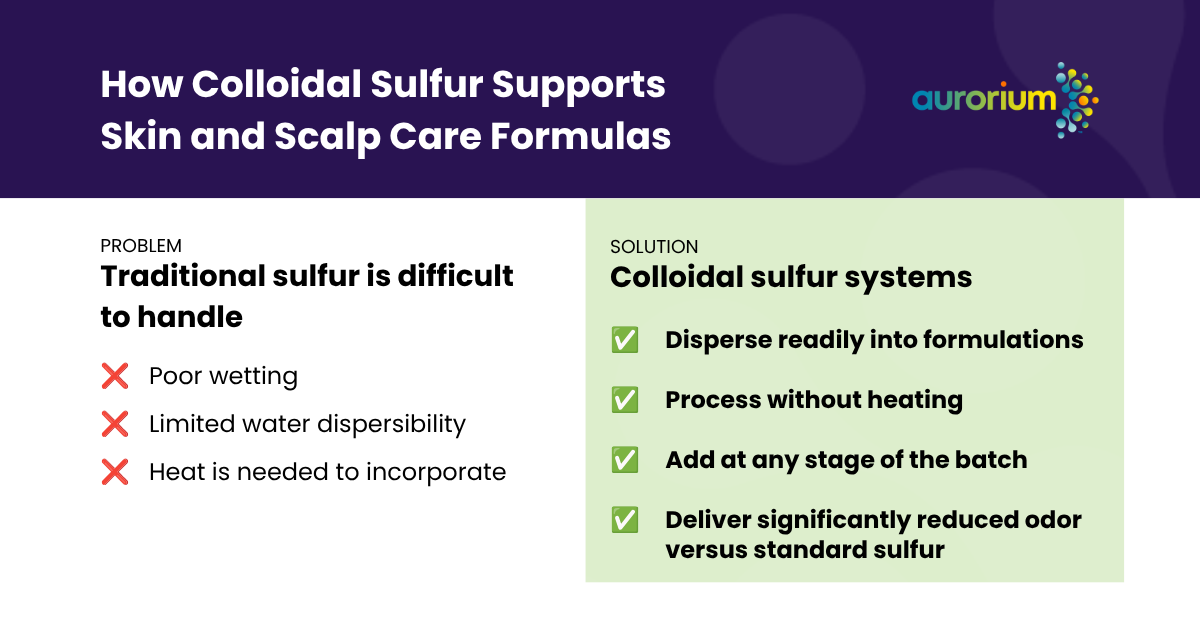
While sulfur is well recognized for its benefits in skin and scalp care, formulating with conventional sulfur can be challenging. Its poor wetting properties and limited water dispersibility can complicate formulation, while its characteristic odor, often associated with rotten eggs, may negatively impact the sensory profile of finished products. These limitations have driven the development of novel sulfur delivery systems designed to make the formulation process easier and improve consumer acceptance.
This is where purpose-designed colloidal sulfur systems offer significant advantages.
Sulfidal™ Colloidal Sulfur (INCI: Sulfur (and) Acacia Senegal Gum) is a stable colloidal dispersion of ultra-fine sulfur particles in Acacia Senegal Gum, offering several advantages over traditional sulfur formats.
Reduced Odour and Easier Handling
Colloidal Sulfur exhibits a significantly reduced odor compared to standard sulfur. The reduced odor of colloidal sulfur enhances the overall sensory experience of the formula, making it more appealing to consumers.
Sulfidal™ Colloidal Sulfur is designed to disperse readily into formulations, without the need for additional processing steps. Its unique colloidal structure makes it easy to incorporate into formulations, helping reduce some of the processing challenges commonly associated with traditional sulfur formats.
Colloidal sulfur exhibits a significantly reduced odor compared to standard sulfur. The improved odor profile enhances the overall sensory experience and consumer acceptance. This allows brands to develop sulfur based products that deliver therapeutic benefits without the sensory associations linked to sulfur.
Cold Processing and Batch Flexibility
In contrast to certain sulfur compounds that necessitate elevated temperatures for incorporation into formulations, Sulfidal™ Colloidal Sulfur can be processed without heating. is designed to support easier incorporation into personal care formulations while offering formulators flexibility around manufacturing processes and ingredient addition.
The capability to process colloidal sulfur at lower temperatures not only streamlines the manufacturing process but also aids in maintaining the stability and efficacy of other heat-sensitive ingredients within the formulation.
Sulfidal™ Colloidal Sulfur provides formulation flexibility, as it can be introduced at any stage of the process—either at the beginning of the batch or as the final ingredient. Incorporating colloidal sulfur later in the process enhances flexibility regarding odor control, processing efficiency, and stability of the finished product.
Opaque Systems, Stability and Thickener Considerations
In products such as shampoos and cleansers, colloidal sulfur is best suited for opaque formulations.
Colloidal Sulfur requires adequate suspension to maintain long-term stability in shampoos and other formulations. It is essential to select rheology and suspending agents with the entire system in mind, ensuring compatibility with all components in the formula. Depending on the specific formulation, one or more thickening or suspending polymer systems may be necessary to ensure long term stability, consistent dispersion, and reliable efficacy throughout the shelf life of the formulation.
Where Sulfidal™ Fits in Modern Personal Care Formulations
Sulfidal™ Colloidal Sulfur provides formulators with a sulfur format designed for modern personal care development.
Suitable for applications including acne treatments, facial cleansers, spot treatments, dandruff preparations, scalp treatments and shampoos, it offers flexibility in wash-off and leave-on systems.
From a formulation perspective, the practicality of colloidal sulfur is evident. It is a multifunctional and versatile ingredient, allowing flexibility across various treatment categories and product formats. This simplifies the formulation and manufacturing processes while enhancing the consumer experience through its desirable efficacy profile.
Beyond formulation flexibility, Sulfidal™ Colloidal Sulfur provides brands with an opportunity to build treatment-focused product platforms around a scientifically validated active ingredient with a long history of use in skin and scalp care.
Optional Synergy Route: Sulfidal™ Colloidal Sulfur and Niacinamide
Niacinamide is an effective complement for Sulfidal™ Colloidal Sulfur in formulations designed for blemish-prone skin.
When used together, niacinamide and colloidal sulfur can support formulations that address visible oiliness, help maintain the skin barrier, and reduce the appearance of redness. Colloidal sulfur targets excess oil, skin buildup, and visible blemishes, while Niacinamide supports the skin barrier and helps diminish the appearance of redness, making this combination particularly effective for daily acne care.
Key Takeaways
Colloidal sulfur remains a valuable multifunctional active ingredient for modern personal care formulations. In skin care, it helps address visible blemishes, excess oil, and redness. In scalp care, it supports anti-dandruff formulations that improve scalp comfort and reduce flaking. The colloidal format enhances formulation flexibility, handling characteristics, and incorporation into contemporary treatment-focused products.
Explore Sulfidal™ Colloidal Sulfur
Whether you are developing acne treatments, scalp care products, facial cleansers, or next-generation treatment-focused formulations, Aurorium’s technical experts can help evaluate how Sulfidal™ Colloidal Sulfur may support your formulation objectives. Contact our team to discuss your formulation requirements or request additional technical information.